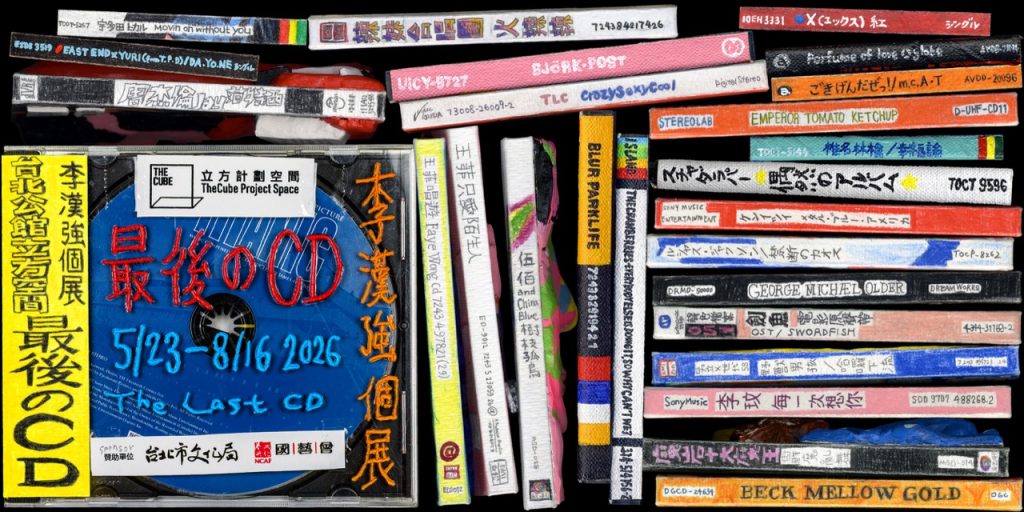
TheCube Project Space is pleased to present LEE KAN KYO: The Last CD, a solo exhibition by Tokyo-based Taiwanese artist Lee Kan Kyo, opening on May 23, 2026. Curated by Wei Yu, the exhibition continues the artist’s recent engagement with “old media” and media archaeology. Through the meticulous hand-reproduction of hundreds of CD covers, Lee invites viewers to reconsider how East Asian popular culture circulates through material objects and technical memory, while reflecting on the rapid production and consumption of images and sound in the digital age.
Located in Taipei’s Gongguan district—once a dense hub of record stores in the 1990s—the exhibition draws from the site’s layered cultural memory. Through reconstructed CDs, sound installations, and spatial interventions, the exhibition transforms the space into a sensory environment situated between a record shop and a media archive. Within this familiar yet reimagined landscape of images and sound, viewers are invited to recall personal and collective memories, and to reconsider the relationships between media, emotion, and circulation.
About the Exhibition
The Last CD: Lee Kan Kyo’s Media Archaeology of the Future
By Wei Yu
Lee Kan Kyo’s practice re-produces the surplus imagery of contemporary capitalist society through labor-intensive and deliberately “clumsy” painting techniques. His subjects range from streaming stills and supermarket flyers to tabloid magazine covers. In recent years, his focus on contemporary “old media” has become a central trajectory in his work.
In his 2022 exhibition Lee Kan Kyo’s NFT, he began re-drawing DVD covers in a signature style, referencing the Japanese multimedia rental chain TSUTAYA with his project Bird’s Nest Video. For Lee, TSUTAYA—one of the few remaining DVD rental networks in Japan—functions as a kind of archaeological site of old media in the streaming era. The following year, his localized version Han-Chiang Video, presented at C-LAB Taiwan Contemporary Culture Lab, responded to the disappearance of Taiwan’s former rental chain Asia Video. His act of redrawing operates simultaneously as imitation, reproduction, adaptation, and a form of “aestheticized piracy,” re-materializing the hardware forms of DVD culture—its packaging, display systems, and storefront logic. This project establishes an unusual intertextual relationship between old and new media: to draw is to burn.
Following DVD-burning culture, Lee’s media-archaeological excavation turns to CDs. Introduced in the mid-1980s, CDs not only replaced analog formats such as vinyl and cassette tapes, but also revolutionized sound reproduction through digital sampling. In The Last CD, Lee continues his “aestheticized piracy” by excavating the culture of the mini single CD—a format particularly popular in Japan during the late 1980s and 1990s. Unlike the standard 12 cm CD, these 8 cm discs were packaged in elongated cases resembling tanzaku—narrow strips of paper used for writing wishes during Japanese festivals—hence the name “Tanzaku CD.” Though less widespread in Taiwan, they became prized collectibles among fans of Japanese pop culture.
Like DVDs, CDs declined earlier under the impact of MP3 and peer-to-peer file sharing technologies. The title The Last CD carries a double meaning: in Japanese, it can also imply “saving the best for last.” Lee’s project captures both the disappearance of an obsolete medium and a gesture of tribute.
From DVD to CD, Lee’s practice forms a distinct trajectory of media archaeology. Since its emergence in the 1980s, media archaeology has focused on obsolete, overlooked, or marginalized media technologies, emphasizing materiality, technical conditions, and non-linear histories. Rather than following a linear narrative, it investigates ruptures, residues, and forgotten forms as they re-emerge.
Lee’s artistic media archaeology reflects not only his personal memory as a millennial media consumer, but also an excavation of futures that have already passed. Once symbols of technological futurity—with their reflective metallic surfaces—these media formats now return as nostalgic artifacts within contemporary culture. This “outdated futurity” has become a distinct aesthetic sensibility, particularly among younger generations, evoking imagined histories and stylized temporalities.
His method of deliberate clumsiness resembles an amateur’s imitation of canonical imagery—yet the canon here consists entirely of mass-produced cultural products. In an age shaped by algorithm-driven content production, Lee’s re-drawn images introduce a subtle resistance, re-inscribing these cultural artifacts with ambiguity and affect.
What stands out in his work is its labor-intensive nature. Through repetitive, seemingly endless acts of reproduction, Lee generates a form of embodied production that transforms monotony into intensity. Echoing conceptual art practices of the 1970s—such as Tehching Hsieh’s phrase “using quantity to replace quality”—his work materializes repetition itself.
One example is his ongoing Juicebox Selfie project, in which he posts a daily selfie with a bottle of vegetable juice, accumulating over 2,800 images. In this process, Lee becomes not only an artist but also a performer of repetition, shifting the notion of artistic subjectivity toward a mode shaped by cultural production systems.
In this exhibition at TheCube Project Space, Lee transforms the gallery into a site resembling a record store, presenting hundreds of reconstructed CDs, including Japanese 8 cm singles and Taiwanese 12 cm albums, alongside “ghost versions” made from compressed or burned digital files. Situated in Gongguan—historically a district of secondhand record shops—the exhibition resonates deeply with the site’s local memory and cultural context.
Straddling the boundary between contemporary art and popular culture, Lee’s practice navigates between mass production and craft, materiality and memory, excavating both the physical and spectral remains of CD culture.
About the Artist
LEE KAN KYO
Born in Taipei, Taiwan, LEE KAN KYO has been based in Tokyo since completing his Master’s degree in Design at Tokyo Zokei University in 2012. His practice centers on fragments of everyday media from contemporary consumer society, meticulously reconstructing them through handcrafted processes to reexamine their forms and meanings, uncovering the subtle sense of strangeness and layers of memory hidden beneath rapid cycles of consumption. Drawing from materials such as supermarket flyers, weekly magazines, and CD packaging, he reconstructs these mass-produced images to reveal the overlooked tensions between personal memory and collective consumption. Through long-term projects such as the Supermarket Flyer Series, juicebox selfie, and the LEE Disc Project, his work critically explores the overlooked textures of mass production and everyday life. In 2014, his project “Dream anoko(Don’t stop)”received the “1_WALL” Graphic Art Award in Japan, and he was named Artist of the Year at GQ Taiwan MOTY 2022. He has created artwork for Supreme, Kikuchi Naruyoshi Q/N/K, KIRIN Taiwan, Quaker, Netflix Wave Makers, UNIQLO, WIND AND SEA, RhinoShield, among others.
LEE KAN KYO’s Website:https://leekankyo.com/
About the Curator
Wei Yu
Curator, art critic, and Assistant Professor in the Department of Sculpture at National Taiwan University of Arts. He received his MA in Art History and Art Criticism from Tainan National University of the Arts in 2003, and later served as Editor-in-Chief and contributor for Artco Monthly. He earned his PhD in Humanities and Cultural Studies from Birkbeck, University of London in 2020. From 2018 to 2023, he worked at C-LAB Taiwan Contemporary Culture Lab as Senior Researcher, Head of Research, and Curator, where he organized numerous exhibitions and programs, including the 2023 annual exhibition Palace of Memory Collapse, marking his first collaboration with Lee Kan Kyo.
Events
1. Opening & Panel Talk
Date: Saturday, May 23, 2026, 2PM (Door at 1:30pm)
Speakers: Lee Kan Kyo, Wei Yu, and Shih-Lun Chang
Venue: TheCube Project Space
*This event will be conducted in Mandarin.
Organizer| TheCube Project Space
Sponsors| National Culture and Arts Foundation, Department of Cultural Affairs, Taipei City Government
Time|2026.5.23 – 8.16, 2-8pm, Wednesdays to Sundays
*Note: TheCube will be closed for summer break from July 6 to July 31.
Venue|TheCube Project Space (2F, No. 13, Alley 1, Lane 136, Sec. 4, Roosevelt Road, Taipei)
Artist|LEE KAN KYO
Curator|Wei Yu
EVENTS
1. Opening & Panel Talk
Date: Saturday, May 23, 2026, 2PM (Door at 1:30pm)
Speakers: Lee Kan Kyo, Wei Yu, and Shih-Lun Chang
Venue: TheCube Project Space
*This event will be conducted in Mandarin.
Date:
2026 年 4 月 11 日