Sjana-i maw! Let’s Play / Let’s Explore: Exploration and Collaboration across Skadang X Kipatauw
- 2026.11.28 — 2027.1.17
- TheCube Project Space
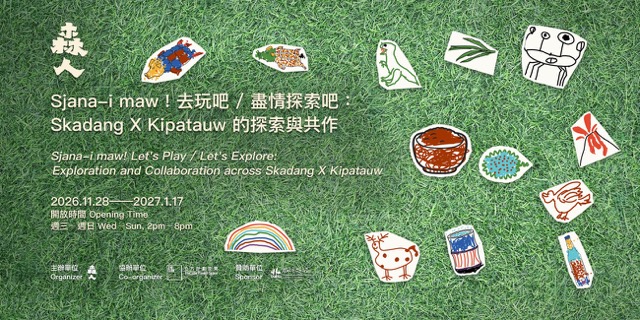
TheCube Project Space is delighted to partner once again with Tree Tree Tree Person – Taroko Arts Residency Project to present Sjana-i maw! Let’s Play / Let’s Explore: Exploration and Collaboration across Skadang X Kipatauw. Continuing a dialogue between two places, this year’s residency research moves between Skadang in Taroko and Kipatauw in Beitou. Earlier this year, the Tree Tree Tree Person Beitou team closed Splicing Time: A Ketagalan Notebook at the Ketagalan Culture Center with a phrase in the Basay language: “Sjana-i maw!” That phrase now opens this exhibition, as the research turns from historical archives back to everyday life.
The exhibition brings together five resident researchers: Natnaree Riewpaiboon (Qwarux), Szu-ni Wen, Hsiang-Lin Kuo, Jing-Yun Ou, and Wei-Yu Lu. They spent time in family homes, on mountain trails, and in churches and temples. Their research ranges from the names of plants and women’s labor to mountains packaged for leisure and the processions of deities. Through field journals, weaving, a treadmill video installation, map drawings, and a site-specific work on the rolling shutter door of Baode Temple, they record what happened when they encountered these places and their people. The exhibition is in no hurry to give answers, and it does not paint a romantic picture of Indigenous homelands. It brings unfinished stories and ongoing relationships into the gallery and invites visitors to stay curious and explore along with them.
Exhibition Introduction
In early 2026, the Tree Tree Tree Person Beitou team curated Time Jumps: A Ketagalan Notebook at the Ketagalan Culture Center. Digging through historical documents and field notes, we gathered intriguing fragments of memory and tried to look beyond the usual chronological telling of history. We wanted to rediscover a place where cultures are constantly changing, continuing, and taking on new forms. We ended that exhibition with a phrase in the Basay language: “Sjana-i maw!” (Let’s play! / Let’s explore!). Following the footsteps of a “Tiger God pretending to be a cat,” we invited everyone to stay curious and set off on a journey with no fixed destination.
Now, “Sjana-i maw!” has become the starting point for our next exhibition.
At the end of 2026, Tree Tree Tree Person brings together five artists and researchers at TheCube Project Space: Natnaree Riewpaiboon (Qwarux), 溫思妮, 郭向凌, 歐靜雲, and Lu Wei You (盧威佑). Through their research and creative practices in Skadang, Taroko, and Kipatauw, Beitou, they invite us to encounter these places from different perspectives. Continuing our curiosity about history and local memories, this time we move beyond the archives and return to everyday life. What happens when researchers spend time in a place, meet its people, and discover things they never expected?
This is not an exhibition that rushes to offer answers, nor one that presents a romantic image of Indigenous homelands.
Thai artist and cultural practitioner Natnaree Riewpaiboon (Qwarux) initially set out to discover stories hidden in the names of plants. In An Imaginary Field Journal: Encountering Plants, People and Places, she finds that relationships between people and plants reach far beyond what words can capture. She begins keeping a different kind of field journal, one filled with memories and imagination, recording not only plants but also people, animals, and those hard-to-define feelings encountered along the way.
In 下上下上 (Down, Up, Down, Up), 溫思妮 draws on her experiences of learning to weave and work with rattan. Some things need to be pulled tight; others simply cannot be rushed. Somewhere between tension and patience, she reflects on the changing forms of everyday labor among women in the Skadang community, and how they continually adapt to shifting circumstances. From the mountains to the city, from past to present, life often calls for finding new ways to carry on.
For 郭向凌, walking in the mountains is no longer simply a pleasant hike. In unromanticization 1:1, once the trees, paths, and pieces of land begin to reveal their own names, stories, and histories, even familiar landscapes start to feel different. Up in the mountains, Rihanna plays through a Bluetooth speaker, while plastic baskets ordered online and convenience-store rice balls become part of everyday life. A treadmill playing footage of hiking trails raises another question: when we see the mountains primarily as places for recreation and consumption, what might we be overlooking about the people who actually live and work there?
Moving from Taroko to Beitou, exploration takes another turn.
In 家族樹-日常的製圖學 (Family Tree: A Cartography of Everyday Life), 歐靜雲 spends time around the New Beitou Presbyterian Church and Baode Temple, collecting everyday stories through conversations, gatherings, and observations. She explores the possibility of creating a map of Beitou that traces not only streets and buildings, but also emotions, memories, and relationships. Beneath the familiar streets and everyday scenes of the city, there may be many stories still waiting to be heard.
Lu Wei You (盧威佑), in A Place Passed Through, turns his attention to the worship of Chi-Fu Wangye at Baode Temple, following the movements of religious processions, local lion-dance traditions, and the temple’s own history of relocation. As deities pass through the streets and people gather in front of the temple, stories of the place continue to move with them. Even an ordinary metal roller shutter might become a new doorway into Beitou’s religious life and local memories.
From the names of plants to women’s labor, from mountain trails to churches and temples in the city, these five researchers set out with different curiosities and encountered people and experiences they could not have anticipated. Perhaps the most ordinary moments of everyday life hold stories about a place that we have yet to discover.
If A Ketagalan Notebook was our way of asking questions about the past, this residency exhibition brings those questions back into the present. We want to see what stories remain untold, what relationships are still unfolding, and what else we might do together.
For us at Tree Tree Tree Person, research does not always begin with a clear question, nor does it necessarily end with an answer. What matters is whom we meet along the way, what we discover, and how these encounters change the way we understand a place.
This exhibition is simply one gathering along a much longer journey. There are still so many places to go, and so many things to be curious about.
Sjana-i maw! (Let’s play! / Let’s explore!)
About the Curatorial Team
Project Director / Curatorial Convener
Cheng-Tao Chen Founder of the Tree Tree Tree Person Project. Responsible for the project’s overall framework, resource integration, and cross-community connections, he is dedicated to exploring ethical practices for artist residencies within traditional territories by transferring decision-making power to local communities.
Curatorial & Project Team
Ūn-Kiat Tsan, Jia-Rong Hsu, San-San Liu, Frankie Su As partners within the curatorial meshwork, the team is responsible for field research, resource matching, community communication, and event planning. Particularly in Beitou, the members collaboratively develop and transform the annual themes, serving as an indispensable force in this co-working model. For instance, in 2025, the team curated the project The Soil Underfoot Holds the Faith of a People, which focuses on the “Tingshe” area of Sancengqi, a traditional territory of the Ketagalan Beitou community, organizing a series of talks, workshops, and field walking tours.
Local Curators & Selection Committees
Taroko Datong Community Women’s Association Serving as the core curatorial team since 2018 , they hold the final voting power in selecting resident researcher proposals. With their profound mountain wisdom and life aesthetics, they substantially guide the direction of the Taroko Arts Residency Project. Members include Cumey Hrosi, Icyang Pasang, Kumu Unang, Qurug Tumiyu, Simat Qurang, Tumun Masaw, Yeyku Rikaw, Yaya Huwat, Bnu Pasang, and Yuri Pasang.
Beitou Baode Temple Participating in the selection process for the first time in 2025, members, as descendants of the Beitou Ketagalan community and guardians of local faith, led by Temple Master Mr. Pan Kuo-Liang along with temple devotees, provide crucial local perspectives. They jointly selected the “KNARPAY: Passing Down” writing project and resident researchers.
About the Residency Research Projects
An Imaginary Field Journal: Encountering Plants, People and Places, Natnaree Riewpaiboon (Qwarux), 2026
Botanical records are built to be neutral. To produce reliable knowledge, they set aside the relationship between the person observing and the plant being observed. This approach has given us a remarkable understanding of biodiversity, yet it may also have quietly widened the distance between nature and those of us who are not botanists.
I became curious about keeping a different kind of record: my own memories, experiences and imaginings of plants, and of the people, animals and places that surround them. An archive of impressions, rather than of accuracy.
In An Imaginary Field Journal: Encountering Plants, People and Places, I write myself into the record, along with everything that co-exists with the plants. The journal makes room for what is seldom counted as knowledge: a conversation on the trail, a dog bounding towards me, a passing feeling, the atmosphere of a place as I remember it. Now and then, I step into other people’s memories and let my imagination follow.
The Tree Tree Tree Person Art Residency brought me to two communities: Truku families in Shakadang, Hualien, and Kipatauw in Beitou, Taipei. I arrived hoping to collect plant stories by following the clues hidden in Indigenous plant names, as I had often done with Thai and Chinese names, where a single word can hold a whole tale. Instead, I found that the Truku relationship with plants is felt rather than spelled out. It lives in the body, in senses beyond the familiar five, and reaches deep into the spirit. Written language builds meaning word by word; this knowledge is built moment by moment, through living. A name alone can hold only a small part of it. This confirmed my way of working: to get close to a plant, I had to live alongside it, walking, eating, listening and sitting still with the people, animals and places around it.
If we hope to see nature flourish, I believe it is not enough to work with nature alone. We must also restore, and create anew, our own memories of it. And who knows? If you, I, and many others come to share similar memories of a plant, perhaps one day they might be recognised as cultural knowledge.
It is a small and playful practice, and one I enjoy very much.
So come, step into my memories. Nothing would delight me more than if they stirred some of your own. If a plant memory comes to mind, write it down and share it, and become part of my long-term project, An Archive of Plant Impressions.
Natnaree Riewpaiboon, also known as Qwarux
Up, Down, Up, Down, Szu-ni Wen, 2026
In 1804, French inventor Joseph Marie Jacquard improved the loom by using punched cards to control which warp threads were lifted and which were not. This made it possible to turn weaving patterns into instructions that machines could read, and the technology also inspired the later development of computers. Zero and one, lifting and not lifting, up and down—different combinations of these simple actions can create all kinds of complex patterns. Weaving is a slow and complicated process, yet industrial looms became one of the driving forces of the Industrial Revolution, making it possible to produce goods quickly and in large quantities. This history is also interwoven with colonialism, international trade, and transformations in the ways people live.
When Auntie Yeyku Rikaw was born, her family was already buying ready-made clothes, though clothes and shoes were still very precious. She had watched her grandmother weave as a child, but her mother never learned the craft. It was not until she was 45 that she and her younger sister, Saji Rikaw, began learning to weave through a community empowerment program initiated by Taroko National Park Headquarters. Starting with a tabletop band loom and moving on to the traditional Truku ground loom, they learned and practiced weaving again, working with materials ranging from industrial polyester SP yarn to ramie. Gradually, weaving also became a source of livelihood for them as they began making souvenirs to sell at the Taroko Visitor Center.
I took apart a pair of handmade crocheted socks—a souvenir I got from Bangalore, India—unraveling them into yarn. Using the technique Auntie Yeyku taught me, I rewove the yarn into a woven band. Through this process, I also began to question why, as a Han Chinese person, I wanted to learn to weave. Since the Qing dynasty, Han Chinese communities in Taiwan had been importing textiles from elsewhere and had gradually lost the memory and skills of weaving. Now that I no longer need to produce the clothes I wear in everyday life, what does this extremely slow form of physical labor mean to me?
unromanticization 1:1, Hsiang-Lin Kuo, 2026
“During my month of residency in Beitou and Taroko, I was overwhelmed by information on the trails I walked again and again—traditional culture, colonial stories, government policies, neighborhood gossip, personal experiences… I could no longer walk with an empty mind. I kept noticing the names of the trees along the way, gradually came to recognize which plots of land were under ownership disputes, and, whenever I went looking for a ‘toilet,’ nervously checked my surroundings for ancestral graves. Everything along the path suddenly grew noisy, and the leisurely ease of hiking turned into restlessness. But perhaps this bodily sensation is closer to the full reality of this trail?” —Diary, August 2026
After Taiwan’s mountain forests had been exploited and damaged by colonizers, people carried on with the currents of modernization, scientific thinking, and rationalization, attempting to mend their relationship with the mountains by establishing national parks and promoting a culture of leisure. Yet because the concept of the national park is inherited from Western modernism, environmentalism (itself deeply shaped by Romanticism), and consumerism, the mountains have been forcibly split off from the everyday life of modern urban dwellers. Applying an imported system to the unique history of an island nation seems to overlook local aesthetics and perspectives, and in fact extends the shadow of the colonial past. When the mountains become a consumable (utopian) paradise, the affluent middle class can consume their natural and cultural assets at will. Approaching the mountains in the name of outdoor recreation does bring them, to some degree, closer to modern life. This mode of interaction, however, flattens the complex reality the mountains have inherited, with its many perspectives and dimensions, and easily leaves people feeling alienated and disconnected from what is real about them.
During my brief residency, I was fortunate to enter the daily lives of community members, and that gave me the chance to encounter another reality the mountains are living through. In my daily walks there were none of the mountain songs, weaving, or bamboo-tube rice I had imagined; instead there was Rihanna’s voice from a Bluetooth speaker, plastic “bamboo” baskets bought on Shopee, and FamilyMart rice balls. These small details of everyday life quickly extinguished the illusion of paradise I had carried with me. For this reason, unlike my original proposal, which suggested using tools (clothing) as a medium for exploring how people interact with the mountains, during the residency I began instead to focus on the body (labor) as the starting point for embodied observation. The ultimate expression of the mountains being absorbed into a consumable leisure product is surely the touchscreen treadmill that plays immersive, interactive videos of hiking trails. In this work, though, what I want to explore is whether, within a highly commercialized device of modern recreational exercise, there still exists a subtle, narrow gap: one that can be absorbed into the system and yet allows me to discover what lies outside it.
Installation: An (abstracted) treadmill playing an immersive video of hikes in Taroko National Park and along Fanzai Creek (番仔溪) in Beitou.
Family Tree: A Cartography of the Everyday, Jing-Yun Ou, 2026
As the very name Beitou suggests (a transliteration of Patauw, the Ketagalan word for “witch”), when we try to understand the Beitou area we tend to focus on images of the Japanese colonial period and of modern life, because the area retains so many buildings and everyday landscapes with vivid visual and historical symbols. The visual traces of the Beitou community, by contrast, have already been blended and liquefied, flowing in composite forms through every corner of the city.
This collaborative project takes as its bases Taipei’s Independence Presbyterian Church in Xinbeitou (自立長老會新北投教會) and Baode Temple, a temple rooted in folk religion. With members of the Beitou community who gather for weekend social or religious activities, it sets out to wander through personal histories, looking for each individual’s practices of living through conversations, casual notes, and marked drawings, and then filling these stories into a geographical framework. It further explores the collective portrait drawn within the modern city by a Beitou community that, through “liquefaction” and “symbiosis,” is present everywhere. The project weaves together the map of the mind that the Beitou community has drawn after different contexts and cultural colors have merged and succeeded one another. Through the visible things encountered in everyday life, such as modern living, natural vegetation, and social activities, it seeks to unearth invisible memories, as well as identifications with and imaginings of people, place, and time.
The notes, materials, and drawings that result from co-creating with the many participants will be presented on a two-dimensional medium as a map of a landscape of the mind. Using non-linear, decentered modes of description, it charts the multidimensional landscape of Beitou that the community discovers in its everyday events.
A Place Passed Through, Wei-Yu Lu, 2026
This project takes the rolling shutter door of Baode Temple in Beitou as its site. Centered on the worship of Lord Chi (Chifu Wangye, 池府王爺), it incorporates the ritual postures of the temple’s xiaofa ritual troupe (小法團) and the movements of the huan-a lion (番仔獅) troupe unique to Beitou, composing a ritual landscape where the realm of the gods and the human world meet.
“Passing through” refers not only to the ritual processes of the deity’s inspection tours and the troupes’ processions, but also extends to the history of Baode Temple’s relocations, reflecting on how a temple, as the local environment and residents’ lives change, sustains its faith across different spaces and leaves behind historical traces that belong to the place. From the deity’s processions and the temple’s relocations to the gathering of people, these movements and changes together make up local memory, and make faith a medium that connects the land, the generations, and the feelings of residents.
The rolling shutter door, the support for this work, is not only the interface through which one enters and leaves an architectural space; it also carries the spatial relationships of everyday life, between opening and closing, inside and outside. By intervening in the public space around the temple, the work extends the imagery of faith that originally exists within festivals and rituals into the everyday scenes that residents pass by and look at. It allows local culture to remain visible in another form, lets people sense how traditional belief continues and manifests in contemporary public space, and regards Baode Temple as a public landmark that carries local culture and collective memory.
About the Resident Researchers
Natnaree Riewpaiboon (Qwarux)
Natnaree Riewpaiboon is an independent Thai art and cultural practitioner. She researches, produces and manages community-based art interventions in and beyond Bangkok, focusing on environmental, cultural and intergenerational themes.
Believing that to revitalise nature is also to revitalise our memories of it, she explores how the feeling of a memory can be recorded and shared. Through fieldwork, ethnobotanical knowledge and imagination, she collects memories of plants and all that surrounds them, bringing them to life through illustration, writing and mixed media, often with a good dose of humour.
Her practice grows from studies in fine arts (Chulalongkorn University) and cultural and creative industries (Taipei National University of the Arts), along with years of fieldwork informed by anthropological approaches. These have shaped her expertise in community-based art across disciplines, from Low Fat Art Fes and Loei Art Fes with the Prayoon for Art Foundation to BIPAM Route, artist residencies, environmental projects and social campaigns.
Szu-ni Wen
Szu-ni Wen is a theater director and interdisciplinary artist. She moved from Berlin back to Kaohsiung in 2015 and has since focused her research on the connections between Taiwan and Asia. In recent years she has been doing fieldwork in her own homespun, do-it-yourself way. Fascinated by the many facets that people reveal and conceal, she immerses herself in, and learns from, the networks that emerge from the interactions of all kinds of actors. In 2022, as part of the Tree Tree Tree Person – Taroko Arts Residency Project, she and Yin-Ru Lo co-presented the residency work Up Up Down Down, which explored the relationships among mountain climbing, homecoming, labor, and the body in the lives of Indigenous women. In 2025 she took part in the Remapping Asia program at the Asia Culture Center (ACC) in Gwangju, South Korea, directing the work forget me not. She has also independently published the book Plug-ins: Lives of Southeast Asian New Immigrants and Migrant Workers @ Kaohsiung–Pingtung, presented the video work Not a Drop of the World’s Water Will Be Lost at the Hong-Gah Museum’s Shoushan venue in Kaohsiung, and created Straight Man of Steel for the 2026 Kaohsiung International Steel & Iron Sculpture Festival.
Hsiang-Lin Kuo
Hsiang-Lin Kuo is a textile designer and fashion researcher currently based in the Netherlands, where she is pursuing a PhD in the Department of Industrial Design at Eindhoven University of Technology, researching approaches to clothing and embodied design.
Trained as a designer and active in the space between art and design, she has, since 2018, continually experimented with bringing fieldwork methods into her clothing and textile practice, believing that doing things with one’s own body (embodiment) can ground abstract questions. This way of working naturally opens onto discussions of the postcolonial, the postmodern, and multiple modernities, which she is adept at conveying through the metaphors of speculative fabulation.
Her work has been exhibited at Dutch Design Week, Milan Design Week (Salone del Mobile), MOCA Taipei, Taiwan Contemporary Culture Lab (C-LAB), Waley Art, Songshan Cultural and Creative Park, and Shih Chien University, among others. Her work This Is Escapism At Its Best (2017–2018) won an award at the Tokyo New Designer Fashion Grand Prix in 2018 and was presented at Amazon Fashion Week Tokyo.
Jing-Yun Ou
Jing-Yun Ou lives and works in Taichung. Working primarily in painting, he develops his practice around two main themes. The first is natural metaphor and pastoral empathy: combining the narrative approach of natural history illustration with the suburban landscapes of Taiwan, he depicts scenery that has been rewritten and reassembled by human intervention. The second is violence and desire in gender: centering on toxic masculinity, he reveals the distortion and tension of bodies under the forces of war, institutions, and collective experience. In both, he builds open-ended narrative atlases through figurative depiction. His solo exhibitions include Twilight in a Secluded Place (Project Fulfill Art Space, Taipei, 2022), Blazing Fire at Sandy Noon (VT Artsalon, Taipei, 2020), and Delirious Murmurs (FreeS Art Space, Taipei, 2016).
Wei-Yu Lu
Wei-Yu Lu is currently an MFA student in the School of Fine Arts at Taipei National University of the Arts. His practice spans Eastern gouache painting, ceramics, and interdisciplinary theater production.
The core of his work has deepened from the depiction of scenery into an inquiry into the relationships between people and their environment, social roles, and inner psychological states. He is concerned with how individuals form their sense of self within different relationships and spaces, and, by juxtaposing and layering natural and man-made objects as a way for the human figure to appear, he transforms abstract psychological feelings into visual expression.
In his practice, he continues to explore the form, material, and spatial relationships of objects, drawing on the properties of different media to develop ways of expressing boundaries, viewing, and the perception of environment. In recent years, through research into ceramic craft and interdisciplinary production experience in theater sound and video design, he has also expanded the possibilities of his work in spatial narrative, visual translation, and site-specific creation, seeking to connect his works with their surroundings and local contexts.
Organizer|Tree Tree Tree Person
Co-organizer|TheCube Project Space
Sponsor|Department of Cultural Affairs, Taipei City Government
Exhibition Program
- Field Writing Project Presentation: KNARPAY: In Search of Invisible Landscapes
Date & Time: Sunday, 29 November 2026, 3:00–4:00 PM
Moderator: Cheng-Tao Chen
Speakers: Andy Yen, Alex Lu
Venue: TheCube Project Space
Alongside the five artists’ residency research presentations, Tree Tree Tree Person invites you to explore Beitou through field writing. - Tree Tree Tree Person 2026: Exhibition Tour & Artist Talk
Date & Time: Friday, 4 December 2026, 6:00–8:00 PM
Venue: TheCube Project Space