Making Exhibitions: The Becoming-together of the Neighborhood
- 2026.8.22 — 8.30
- 立方計劃空間
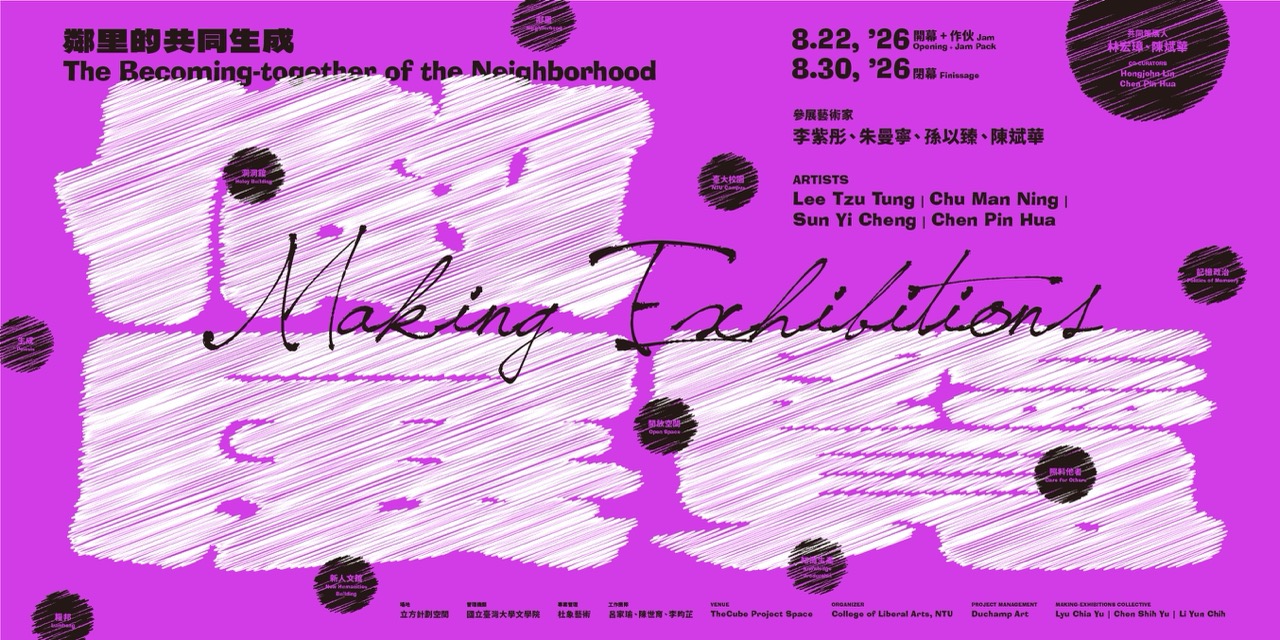
Making Exhibitions: The Becoming-together of the Neighborhood is a concrete imagining of neighborhood relations in the broad sense of the National Taiwan University (NTU) campus, generated collectively through performance, speech, writing, and artistic action. Just as the etymology of “neighborhood” carries the sense of people in adjacent zones becoming together, so too does this project unfold as an ongoing performance at TheCube: through assemblies, meetings, and chance encounters, we jointly rethink the topology and historical traces of the NTU campus, explore poetic creation, share the life experience common to the public and to those inside and outside the campus, and reach toward an imagination of the future that exceeds the present. It is precisely by reshaping the campus’s existing meaning as an “open space (a public square)” that a collective social ecology can be generated. Proceeding from the poetics of becoming that Making Exhibitions creates, art’s intervention in public space and public affairs becomes an opportunity to drive shared social transformation. This is both the care that creative work projects toward “being-toward-others” and a temporal contribution and commitment — through the co-creation of “dwelling and living together,” and beginning from the aesthetic power of equality between people, it moves beyond the “neighboring community” as previously imagined.
Curatorial Statement
Making Exhibitions emphasizes the practice of artistic performance. Taking the spirit of NTU’s Humanities and Social Sciences Building as its site, the project cultivates the imagination of a “wall-less campus,” reconstructs the topological structure of “public relations,” and puts into practice a public performance of co-learning and co-creation, becoming an existence co-constituted by people together. By turning the exhibition into a poetic act, it transforms people who once walked silently through the campus into co-creators of the performance, converting passive viewing into active participation and generating a new set of public relations. The exhibition project transforms the audience’s dual identity: on the one hand, the audience is liberated from passive viewing — a technique of “disenchantment” applied to the conventional exhibition form; on the other hand, the audience, once a silent recipient, becomes an actively intervening “creator.” Through the topology of the “neighborhood” generated by Making Exhibitions, a poetic act of “equal rights” unfolds across the NTU campus, transforming the historic site once known as “Dongdongguan” (literally, the “Hole-Hole Hall”) into a performance of project-based creation, joining the wall-less campus with the surrounding social space to form a relationship of neighborhood becoming-together.
Making Exhibitions seeks to embody a form of “practical wisdom,” much as the pioneering independent curator Harald Szeemann proclaimed: rather than being called a “curator” or a “director,” he named himself an Ausstellungsmacher — an “exhibition maker.” Szeemann wished to shed the conventional, normative role of the “curator” and to open curating up as a poetic act of creation. By emphasizing “making” and the question of “how to make,” he reframed the relationship of transforming and producing art, turning everyday life into artistic performance and linking it to the poetic sense of “generation” (poiesis) rather than to “aesthetics” understood merely from the recipient’s standpoint. Szeemann’s curatorial practice manifested an atmosphere of “openness” that broke down the boundaries between performer, viewer, and participant, freeing the exhibition from its fixed site within the “white cube” so that it could become a public event and re-map the exhibition’s topological relation to public space. This idea originated in his theatrical experience of the 1950s, which allowed the “artwork” to break through the constraints of the “institutions of art,” redefining the public role and spatial configuration of the exhibition and shifting the position of the curator. He relinquished the traditional duties of the museum, curating instead within a broader cultural context, and offered a liberated paradigm of “making exhibitions.” The subtitle of his legendary exhibition When Attitudes Become Forms — Live in Your Head — meaning something like “a live performance inside the head” or “living it out from the mind” — further underscores the identity he emphasized: that of the “maker” of a creative poetics.
On another front, the etymology of “exhibition” points to a “presentation” made to the public — a putting-forward and a giving. Ever since the museum system took shape in the eighteenth century, the exhibition has manifested as a public site. Seen from the standpoint of “giving publicness,” an exhibition is not merely a “representation” of some issue, phenomenon, artistic style, or exhibition title; in the history of the museum, the Louvre’s transformation from a royal palace into an art-viewing space open to the public, together with the development of the salon, the gallery, the museum, and even the art school, moved toward an opening onto the “commons,” and the “gathering” of an audience became a condition of the modern exhibition. In other words, the exhibition is a practice of shared viewing among an equally constituted public; it resists established, normative identities and pursues a liberated public sphere. Such an exhibition can release vital energy and unfold creative perception, turning the exhibition into a space of social learning. This is why, especially within “new genre public art,” exhibitions — through creative practice that “re-publics” the dialogical relations of art — perform, extend, and generate public relations, moving beyond the constraints of established exhibition institutions, coordinating and translating dynamic knowledge, and summoning an artistic ethics of plural voices. “Exhibition” does more than organize artworks: it constitutes a situation that redistributes the order of perception and the authority of knowledge, producing an equal “commons.” This publicness does not presuppose a consensus built on “homogeneity”; rather, it unfolds through a continually generated heterogeneity of “becoming-with-the-other,” bringing different life experiences into encounter within the same site and creating the possibility of public connection and transformation.
In the process of “making exhibitions,” the audience’s habitual identity must be transformed. On the one hand, the audience must be liberated from a state of passive viewing, no longer indulging solely in the narrative, illusion, and spectacle that the exhibition presents — an act of “disenchantment” directed at the conventional exhibition. On the other hand, the audience must be liberated from an internally controlled logic of looking, re-examining the power structures at work in the performance and “stepping out of the play” in everyday life. The word “exhibition,” then, actually carries within it a reflection on exhibition politics, the audience, and aesthetic equality (democracy). The three are mutually conditioning: the exhibition provides a concrete site for artistic democracy; the audience’s aesthetic equality gives direction and purpose to the exhibition’s political efficacy; and democracy, as the foundational value of equality, secures the standing of both. In this way, the audience is no longer merely a passive recipient but can enter into creation and discussion in a collaborative posture. It is worth noting that “campus” originally meant an “open field.” When the boundary of the “campus” is dissolved, becoming a site of dual intervention — both real and symbolic — the relationship among the three becomes still more concrete: an open campus not only removes the physical boundary of the wall but also loosens, symbolically, the line between academy and society, challenging the structures of authority that govern categories of knowledge. “Making Exhibitions” turns the audience into participants, unfolding creation, dialogue, and action directly at the border between campus and society. In this way, performance, artistic politics, and aesthetic equality form a dynamic system within the “open campus” — one of mutual pull and mutual provocation — continually generating new meanings of publicness over the course of the performance.
The interweaving of the exhibition, artistic politics, and aesthetic equality is generated through the practice of “making.” “Making exhibitions” gradually distances itself from the form of the museum’s white cube — even where the museum’s own trajectory is not entirely abandoned, the performance is no longer merely a “vertical” curating of collection or retrospective, but instead manifests a “horizontal” curatorial concept through exhibition-making. The exhibition is no longer just a tree-like distribution of power, or a demarcation of art-historical style. In the contemporary moment, the practical wisdom embodied in “making exhibitions” becomes a self-generating performative mechanism that opens new space for the art system — indeed, a mode of operating as a parallel organization, a “hyper-horizontal” exhibition. Within this strategy of practice, the relationship between the artwork and labor, and the division between public and private space, are redefined; the roles of audience, artist, and participant are reshaped collaboratively. Contemporary performance especially emphasizes “performativity”: the exhibition is no longer solely a presentation of artworks but becomes an occasion to rethink performance itself. The techniques and strategies of curating, as a mode of artistic presentation, are not merely auxiliary tools outside the performance but objects of perception and address in their own right. Through the public space of performance, the audience gains an open aesthetic experience that belongs to both the individual and the world. The aesthetic manifestation of “making exhibitions” reflects the complexity of contemporary art, encompassing the planning of performance space and the context of artistic language, and carrying the work from the studio into a network of public relations.
On another front, contemporary art is increasingly presented in the form of “projects” rather than fixed, permanent “works.” This is also why project-based creation is always subject to the conditional situation of people, events, and things. It is precisely for this reason that process-oriented art projects are often presented as documents or archives rather than as fixed, unchanging products. Yet a project is not merely temporary — it is at the same time oriented toward the future. To undertake a project is to enter a temporal mode of being, much as Martin Heidegger’s notion of the “project” casts being as thrown toward the future: a future orientation not yet realized but already anticipated, a temporality that promises toward the future, a dimension of time and life that embodies art’s “potentiality.” Project-based creation is always cast toward futurity, and the moment of completion is often at once the moment the project comes to an end. Such creation constitutes a form of liberated artistic labor. Boris Groys, in The Loneliness of the Project, points out that the project in contemporary art mirrors a broader condition of contemporary life: the labor condition of “flexible personality” found in dispatched labor, the gig economy, and temporary contracts. In the same way, such projects lack, in concept, material, and social relation, any stable framework or tradition to rely upon. For the art worker, the challenge lies in how to gather these temporary gestures into a provisional continuity, forming an ever-generative archive of possibility that resists disappearance — and in doing so, reminds us that artistic labor and social labor alike operate within the same economic order.
Making Exhibitions emphasizes the “social turn,” a concept bound up with governance under this same economic condition. By letting performance take place in atypical exhibition venues, the audience acts autonomously in the name of equal rights, reorganizing the order of perception through performance, speech, and writing. The aesthetic proposition this generates is what Jacques Rancière calls “meta-politics” — the dual liberation of aesthetics and politics: it rethinks the concept of topological space, using socially engaged art to explore the multiple meanings held by the exhibition audience, the general public, and those inside and outside the campus. At the same time, the exhibition takes up the presumed social-spatial relations both within and beyond the campus; this unfinished topological condition reflects a political ideology that continues to evolve. In the assemblies, gatherings, and chance encounters of the “neighborhood,” the idea of dingspolitik is manifested — through participation, communication, and collaboration, a public sphere co-constructed by the audience takes shape. Just as the word “neighbor” carries within it the process of “becoming together,” this too drives the social impetus for art’s intervention in public space and public affairs; it is also the “being-toward-others” that project-based creation projects, and, further, a participation and commitment that is fundamentally temporal.
The public relations shaped through exhibitions were also expressed, through “lumbung,” in the curatorial concept of “open space” (ruangrupa) at the 15th Documenta — revealing the cultural and social meaning of collective mutual aid and self-governance. In Indonesia, after the harvest, farmers deposit their surplus into a lumbung (a communal rice barn) to share common benefit, thereby enhancing the community’s long-term welfare and mutual care, and operating according to established rules, collective consciousness, and organizational principles. Together, through assembly and public sharing, they lived and worked in Kassel, Germany, redrawing the boundary between life and art. In Kassel, the artists built numerous spaces that could serve both living and working — kitchens, bars, living rooms, dormitories, vegetable plots, gardens, childcare centers, studios, a library, meeting areas, and exhibition halls — thereby recalling ways of knowing rooted in various sensory experiences as a method of producing knowledge and solving problems. Through the joint participation and interaction of artist collectives and the audience, this curatorial practice rewrote the artistic paradigm of Documenta, challenging the mainstream rationalist thinking and the visual hegemony of artistic knowledge that had long prevailed there, and opening up the possibility of “another” way of knowing art — while also reimagining the future form of shared public space.
Thus, the entire Making Exhibitions project is itself a concrete practice of popular participation. Through project-based creation grounded in doing, co-learning, and co-existing, together with the process and mode of presenting the exhibition, participation is no longer premised on homogeneity, but instead reveals a poetic and aesthetic experience founded on difference. In this sense, the so-called “people” are not a single, averaged whole, but a “multitude” structured into different levels and degrees through artistic practice. These levels can be roughly divided into three: the first consists of those who directly participate and commit themselves to co-creation; the second is the art community formed through the works and the project; and the third comprises the spectators who, in the conventional sense, enter the exhibition space. Understanding traditional notions of popular participation in this way finds a degree of resonance in Claire Bishop’s analysis of “participatory art.” Especially when the human being becomes the very medium of art, the art project often occupies a double position: the work is simultaneously an event that actually takes place in the real world and a line drawn between phenomenon and imagination. Art’s capacity lies precisely in its ability to converse with both the “participant” and the “onlooker” at once, touching on a logic that is often suppressed in our everyday lives. Such practice also unsettles the display logic of the museum and gallery, which centers on the single artwork, attempting instead to steer art toward another level of viewing and participatory experience.
The aesthetic significance of Making Exhibitions lies in restoring the social community, allowing people to become newly aware of their own situation and to gain the energy to act. This is a dual liberation of politics and art, and every liberated person must proceed from the fundamental right of “equality.” The idea that “looking is itself labor” overturns the opposition between looking and acting, allowing the exhibition and the social structure to answer to one another. By blurring the line between the viewer and the actor, dissolving the separation between the individual and the collective body, and ultimately dismantling the boundary of the campus, an “open community” is allowed, through the exhibition’s intervention, to enter everyday social space and to think autonomously about the meaning of artistic democracy. Here, we need to test the capacity of collective collaboration to converge — whether through teaching, performance, lecture, writing, or artistic creation. This capacity operates across a distance that is unpredictable and irreducible, manifesting itself within the topology of an open campus, and poses a lesson to the collective audience: how to stop being merely an audience and instead become an indispensable part of the performance. This is precisely the artistic action through which everyday life brings about transformation, allowing participants to reclaim their own agency and gain the opportunity to learn and change — just as Heidegger’s term “project” itself signifies a projection toward the other and toward the future. Making Exhibitions emphasizes this two-way projection, taking equal art power as its core, allowing people to rediscover their own dignity through labor and opening up a “publicized” relation between self and group. It focuses on three aspects: first, exploring the life and artistic action of lumbung; second, “community participation” that breaks down the boundary between audience and artist; and third, “equality” in artistic creativity. Through these practices, the social-performative configuration of everyday life can redistribute the relations among time, space, persons, and objects, allowing the audience to equally realize its potential and advancing an intellectual equality without distinction. The audience can be both connected and allowed to retain difference, finding its own path through the power of equal rights; in workshops of co-learning and co-creation involving performance, lecture, writing, narrative, and image, they are no longer merely passive recipients but can transform into active creators, further discovering a new relation of “self and group” and revealing the boundless potential of a “re-publicized” exhibition. In this way, the audience is able to become their own “storyteller,” and to let the “self” become its own work.
About the Curators
Hongjohn Lin
Hongjohn Lin is an art worker engaged in creative practice, writing, and curating. He holds a Ph.D. in Art and Humanities from New York University. His work has been included in the Taipei Biennial, the Asia Triennial Manchester, the Guangzhou Triennial, and the China Asia Biennial, among others; he has curated the Taipei Biennial, the Taiwan Pavilion at the Venice Biennale, and numerous contemporary performance projects in Taiwan and abroad. Over the past decade he has developed a conceptual project centered on the pseudo-Taiwanese figure George Psalmanazar, presented as a solo exhibition at IT Park, Taipei, in 2014. He is a professor at Taipei National University of the Arts, with research specialties in interdisciplinary art, aesthetic politics, and contemporary art thought. His art criticism appears widely in journals and magazines at home and abroad, and he has published essays and English-language writing in Art as a Thinking Process, Artistic Research, Experimental Aesthetic, and Altering Archive: The Politics of Memory in Sinophone Cinemas and Image Culture. He edited the books Documents of the 2010 Taipei Biennial, 2010 Taipei Biennial, and Taipei Biennial Lecture Theatre; wrote the prefaces to the Chinese editions of Art Power and Artificial Hells; and is the author of Poetics of Curating, Interdisciplinary Art in Taiwan: Within and Beyond the Boundary, Writing on the Local, and The Curatorial Subject: Contemporary Performance. He curated Immemory (2024) at the Keelung Museum of Art, Taiwan; the 2021–2024 urban public art project To the Ordinary People… Walking in Wanhua; the Taiwan section of the 2023 Istanbul Biennial, Self-Suppressed Island; the inaugural exhibition of the National Center of Photography and Images in 2021, Lifting the Mirror to Meet His Gaze: The First Chapter of Taiwanese Photography (1869–1949); and the Taiwan section of the 2020 Biennale Warszawa, The System of Hyper-Objects. He served as Chief Curator of the Asia Triennial Manchester 2025, and curated The Unfinished Road for the Human Rights Art Festival. Since 2019, he has served as editor-in-chief of the English-language online journal Curatography.
Chen Pin-Hua
Chen Pin-Hua studied at National Taiwan University (transferring between the departments of geography and history before graduating from the Department of Foreign Languages and Literatures), the Graduate Institute of Digital Content and Technologies at National Taiwan Normal University, the Graduate School of Interdisciplinary Art at Taipei National University of the Arts, and the undeclared program of the College of Communication at National Chengchi University. He is currently pursuing a master’s degree at the International Master’s Program in the College of International Finance at National Chengchi University, and heads Taiwan Sustainable Original Content Co., Ltd. He currently serves as a board member of the Taiwan Visual Art Association, and previously served on the board of the Taiwan Photography Culture Association. Drawn to exploring social issues through the archiving of his own everyday life, he has released work under a CC0 public-domain declaration since 2016. His practice engages photography, the environment, copyright, and finance, among other fields; more recently he has also taken part in sound performances and founded the alternative space Kanshousuo (literally, “The Detention House”). His work is included in Photography Interviews 2, and has been exhibited at the Taipei Fine Arts Museum, the National Taiwan Museum of Fine Arts, the Museum of Contemporary Art Taipei, the Kuandu Museum of Fine Arts, and the National Art Museum of China in Beijing; he has also held solo exhibitions at VT Artsalon, the Digital Art Center, Taipei, and the Taiwan International Center for Visual Arts.
About the Artists
Chu Man-Ning
Born in 1994 in Taoyuan, Chu Man-Ning graduated from the Department of Foreign Languages and Literatures at National Taiwan University and from the Graduate Institute of Theatre Arts Creation at Taipei National University of the Arts, majoring in playwriting. A freelance writer, she is a co-founder of the collective Antinomy Collab, where she works as playwright and dramaturg. Her creative practice spans poetry, plays, fiction, and prose, and centers on exploring the subject that emerges at the intersection of relations. She dismantles narrative and reweaves symbol, sound, and gesture into poetry: that which has not yet been named. The collective’s recent work Drifting Upon the Unknown was shortlisted for the 24th Taishin Arts Award. Her recent solo playwriting works include Describing Calcium Carbonate as Pearl, The Silent Moment of Self-Accusation, Zhijuting (The Pavilion of Dwelling in Knowledge), The Way of Gods, Ghosts, and Mortals, and Stardust, Haze, and Gunpowder. Her dramaturgical work includes the first part of the Carnation trilogy, Scenes from a Marriage; The Second Chapter of Lin Mo-Niang Takes Command — Pilgrimage to Bengang; and Bedtime Story, part of the National Taichung Theater’s Summer FUN Time New Art Project.
Lee Tzu-Tung
Lee Tzu-Tung graduated from the Department of Agricultural Economics at National Taiwan University and received full scholarships for an MFA from the School of the Art Institute of Chicago and a Master’s in Architecture from MIT. Her work has been exhibited around the world, including at MOCA Taipei, C-LAB, Cuchifritos Gallery, Stanford University, Tom Robinson Gallery (USA), the University of Lisbon (Portugal), and ArtScape (Canada), among others. Lee is also a convener of numerous political actions, a founder of a collaborative group of artists and technologists, and a curator of cross-disciplinary exhibitions in art and anthropology. Her practice combines in-depth academic research with political engagement. In recent years, taking the narrative and power of “identity” as her point of departure, she has drawn Indigeneity, Sinophone studies, the trauma of modernity, and epistemic justice into the scope of her creative research. She moves freely between performance, net art, new media installation, and experimental film, using art as a method to challenge and decolonize the frameworks of contemporary art, technology, and political rights.
Sun Yi-Cheng
Sun Yi-Cheng is an independent curator and adjunct lecturer at the College of Arts, National Tsing Hua University. She graduated from the Department of Life Science at National Taiwan University and from the Graduate Institute of Interdisciplinary Art (Cultural Production and Curatorial Studies track) at Taipei National University of the Arts. She regards curating as a method of producing alternative knowledge, and continually opens up collaborations with different fields through exhibitions. Her recent curated exhibitions include Co-Sensus (共識覺) (Museum of Contemporary Art Taipei, 2022) and The New Taipei City Art Museum School Partnership Project: Triangular Relations (Rotunda Gallery, New Taipei City Art Museum, 2023); she also took part in the curatorial team for the permanent exhibition nutjaivililj: After the After (Taiwan Indigenous Peoples Cultural Park Museum, 2024).
Chen Pin-Hua
Exhibition Events:
- MAKING EXHIBITIONS Opening+Jam Pack
Date|Sat, Aug 22, 2026, 15:00
Venue|TheCube Project Space
Based on the genius loci of the newly built NTU Humanities Building, Making Exhibitions draws on sympoiesis to activate the public potential of campus space. It transforms the university’s tangible and intangible boundaries into performative contexts for open dialogue. Through workshops, performances, sound, images, and writing, the exhibitionary event invites artists, students, and the public to explore together what art can do and undo. The exhibition not only generates artworks and projects, but also fosters new forms of sociality through relationships among emerging communities. Inspired by lumbung, the collaborative ethos of equality foregrounded by documenta 15, Making Exhibitions continually expands artistic collaboration while reflecting on the production of knowledge, the politics of memory, neighborhood relations, and the purpose of the university. In doing so, Making Exhibitions becomes a social practice that returns to the etymological meaning of campus: an open space.
Jam Pack is an open improvisational sound session inviting participants to use acoustic instruments and sounding objects to explore the possibilities of music and noise alike. There is no prescribed repertoire or performance format. Through collective listening, response, and improvisation, participants co-create a shared experience of sonic becoming. Each session comprises two 30-minute parts, during which participants improvise, respond, and experiment within an open sonic environment, experiencing sound as a fluid, ever-becoming process. - MAKING EXHIBITIONS Closing Event
Date|Sun, Aug 30, 2026
Venue|TheCube Project Space
*For more information, please follow TheCube’s official website and social media platforms.
Supervisor: National Taiwan University
Organizer: College of Liberal Arts, NTU
Project Management: Duchamp Art
Venue: TheCube Project Space