LEE KAN KYO: The Last CD
- 2026.5.23 — 8.16
- 立方計劃空間
- LEE KAN KYO
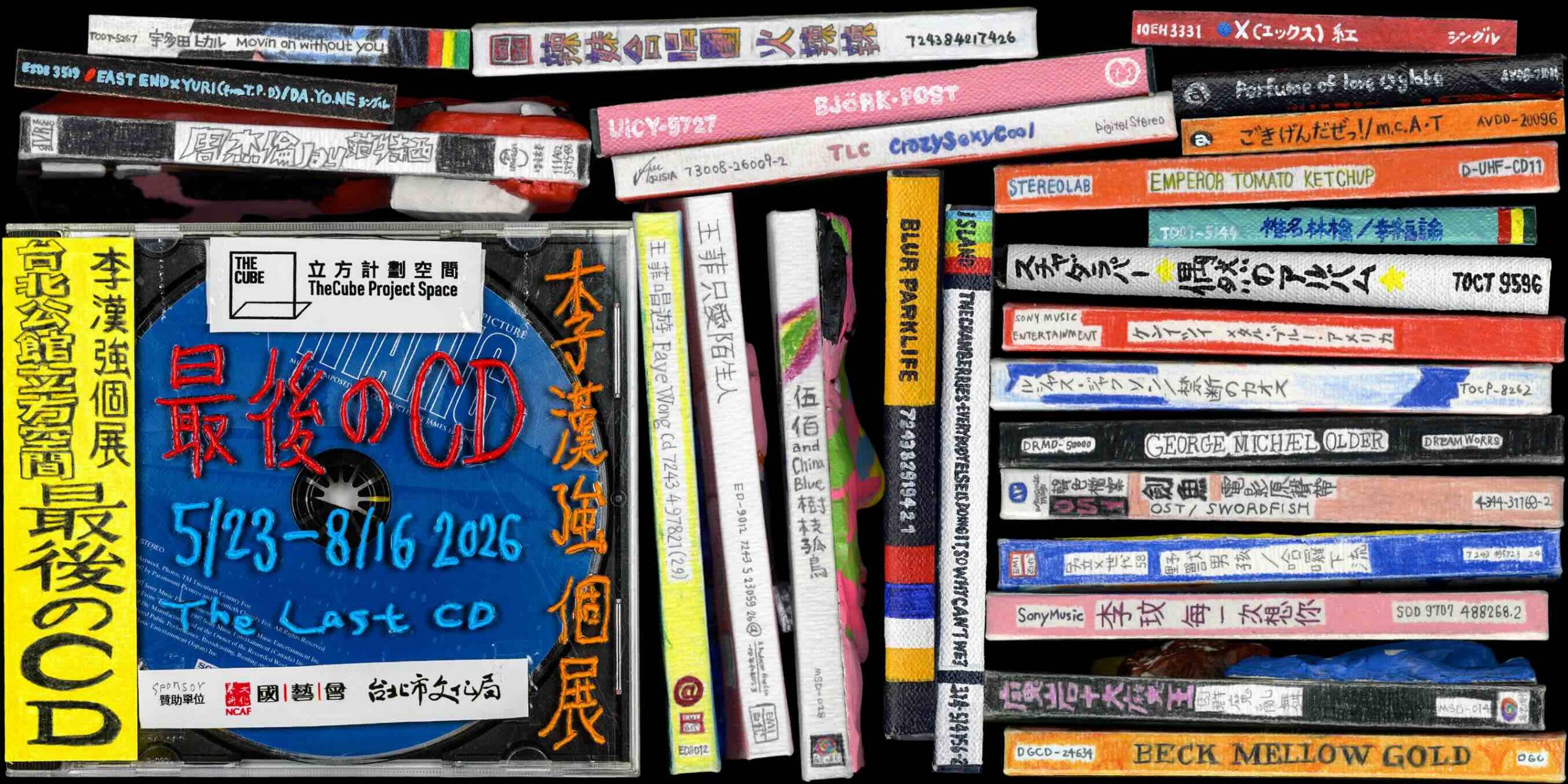
TheCube Project Space is pleased to present LEE KAN KYO: The Last CD, a solo exhibition by Tokyo-based Taiwanese artist Lee Kan Kyo, opening on May 23, 2026. Curated by Wei Yu, the exhibition continues the artist’s recent engagement with “old media” and media archaeology. Through the meticulous hand-reproduction of hundreds of CD covers, Lee invites viewers to reconsider how East Asian popular culture circulates through material objects and technical memory, while reflecting on the rapid production and consumption of images and sound in the digital age.
Located in Taipei’s Gongguan district—once a dense hub of record stores in the 1990s—the exhibition draws from the site’s layered cultural memory. Through reconstructed CDs, sound installations, and spatial interventions, the exhibition transforms the space into a sensory environment situated between a record shop and a media archive. Within this familiar yet reimagined landscape of images and sound, viewers are invited to recall personal and collective memories, and to reconsider the relationships between media, emotion, and circulation.
About the Exhibition
The Last CD: Lee Kan Kyo’s Media Archaeology of the Future
Text | Yu Wei
Lee Kan Kyo’s practice re-produces the surplus imagery of contemporary capitalist society through labour-intensive, deliberately clumsy painting techniques—from streaming drama stills and supermarket flyers to tabloid magazine covers. In recent years, his sustained engagement with contemporary “old media” has become a defining thread running through his work.
In his 2022 exhibition Lee Kan Kyo’s NFT—which had nothing to do with NFTs—he began rendering DVD covers in his signature style, borrowing the name of the Japanese multimedia rental chain TSUTAYA (蔦屋) for his series Bird’s Nest Video. The following year, Han-Chiang Video, presented at C-LAB Taiwan Contemporary Culture Lab, applied the same approach to Asia Video—a Taiwanese rental chain that had quietly shuttered years earlier, unable to survive the streaming tide.
Working in a style that hovers between imitation and adaptation—and, within the logic of audiovisual publishing, something close to aestheticized piracy—Lee re-produced the material culture of DVD in its entirety: content, medium, packaging, distribution, and display. All of this amounts to both a salvage operation on media ruins and an unorthodox tribute to the culture of DVD burning.
※※※
Having excavated DVD, Lee now turns to a new site: the CD. Introduced in the mid-1980s, the CD transformed music consumption—replacing the analog warmth of vinyl and cassette with digital sampling, and driving a far-reaching technological revolution in the music industry. Lee still remembers his first CD: Michael Jackson’s Dangerous.
In The Last CD, Lee applies the same piracy logic to the culture of 1990s music CDs, and in particular the mini single CD endemic to that era’s peak. These 8 cm discs were especially popular in Japan from the late 1980s through the 1990s, and appeared in Taiwan’s record market of the same period as well—never quite achieving the same cultural momentum, but cherished as collectibles by a small contingent of Japanese pop devotees, and marking a distinctly local cultural object shaped by the broader sweep of Japanese popular culture through Taiwan at the time.
CDs were dealt an earlier blow than DVDs in the streaming age: as far back as the late 1990s, the rise of MP3 and peer-to-peer file-sharing—propelled by Winamp and Napster—offered cash-strapped young music fans a dream alternative. The internet promised a nomadic, shared, decentralized, dematerialized experience of music, dismantling not only the physical substrate of the CD but the very concept of the album. In recent years, however, thanks to cultural nostalgia and the K-pop economy, that mirror-finish disc sealed in a clear plastic case has staged something of a comeback among youth culture—though what matters now is often less the audio itself than the photocards and limited-edition inserts inside.
In the 2010s, the Japanese girl idol group AKB48 developed a new music marketing model: physically releasing single CDs with randomly included “handshake tickets” or “general election voting tickets,” prompting devoted fans to purchase CDs in bulk while simultaneously generating a phenomenon of mass CD disposal.[1] Lee collected these mass-discarded idol single CDs and transformed them into a sculptural installation, producing his 2014 project Dream anoko (Don’t stop), which captured the aberrant landscape of material culture manufactured under the operations of the recording industry. In addition to winning Japan’s “1_WALL” Graphic Art Award, it was Lee’s first use of the CD as an artistic material.
As contemporary “old media,” both DVD and CD carried, at the moment of their release, an ineffable sense of the future—their mirror-smooth metallic coatings registering something in material and visual terms that was almost impossible to name. In the streaming age, that “outdated futurity” has become an asset of alternative nostalgia culture. Having lived through the full arc of 1990s CD culture, Lee builds a double meaning into the exhibition title: in Japanese, saigo (最後, “last”) is a homophone of saikō (最高, “best” or “greatest”), so Saigo no CD reads simultaneously as Saikō no CD—“The Greatest CD”—layering onto the title’s literal sense the implication of saving the most treasured, the finest, for last. In naming the series thus, Lee captures both the twilight of an obsolete medium and a gesture of cultural homage.
At the level of visual method, Lee’s deliberate clumsiness—his purposefully off-kilter re-drawing—resembles an amateur’s imitation of canonical imagery. Yet the “canon” here consists entirely of mass-cultural products: standardized, formulaic, engineered to package a consumer’s emotional experience wholesale and deliver it—preemptively—before reflection can intervene, whether in streaming dramas, films, or pop music. In today’s algorithmically optimized streaming environment, the culture industry targets individual taste with ever greater precision. Against this, Lee’s clumsy copies of cultural products generate images of unexpected weight.
Post-postmodernism, appropriation, re-production, homage, and pastiche have become familiar moves—easily metabolized by contemporary audiences. What stands out in Lee’s work is something else: a labour-intensive mode of art-making in which the act of copying is kept deliberately plain, monotonous, and stripped of expressive agency. In the seemingly endless accumulation of these repetitive gestures, something like an embodied productivity emerges.
In contemporary life, repetition tends to breed boredom. Lee’s repetitive practice, however, is not self-depleting—it generates a particular kind of intensity through the sheer volume of sensory production. The clearest illustration of this is his ongoing Juicebox Selfie project. Aligning the temporal logic of a bottle of sugar-free vegetable juice—marketed as supplying “one full day’s worth of nutrients”—with his own lived daily image, he posts a selfie each day on his Instagram account “Lee Kan Kyo’s Juice Selfie,” accumulating 2,858 images to date.[2] Here, Lee is not only an artist but a performer of repetition: the traditionally constituted creative subject is displaced, reconstituted as a product of the culture industry.
This repetitive logic finds its most vivid instantiation in the exhibition through Lee’s version of Mariah Carey’s Christmas album. Like a cultural ritual inseparable from both sweetness and suffering, we are every year inevitably reacquainted with the advent of Christmas through the opening notes of All I Want for Christmas Is You—in films, on the radio, in advertisements, in supermarkets.
Carey has declared that she refuses the concept of time; instead, she chooses to live moment to moment. This refusal has become a recurring trope in her meme-ified public persona: her album’s 25th anniversary was reframed as “25 minutes”; in the #tenyearchallenge, she posted the same photograph twice, rejecting the very premise of a decade’s passage. She draws her fans into an eternal recurrence—a parallel universe of perpetual return.[3] Lee is, in fact, a devoted Carey fan, and his practice carries a similar temporal refusal: in the always-identical form of the daily juice selfie, meaningless routine accumulates across thousands of iterations until it hardens into something like a permanent persona.
※※※
For The Last CD at TheCube Project Space, Lee transforms the gallery into a space that recalls a record shop, presenting hundreds of artistically re-produced CDs: primarily Japanese 8 cm mini singles and Taiwanese 12 cm releases, alongside “ghost versions” made from digitally compressed and burned degraded audio files. There are also batches of CD side labels painstakingly re-drawn by hand, as well as a miniature set re-creating the music video for Kylie Minogue’s single “Come Into My World” in its characteristic psychedelic style. Compared with the spectacle of CD material culture mass-produced and mass-discarded under the grip of the recording industry and its capture of fan culture, Lee’s time-consuming handcraft amounts to a critical rejoinder—and endows fan devotion with a new kind of agency.
The Gongguan neighbourhood where TheCube is located has long been, and remains, a gathering point for record shops: from the early days of Cosmo City, Paidi (派地), Brothers (兄弟), and Classic (經典) through the chain-store era of Rose Records and Eslite Music, to the still-standing stalwarts of indimusic records, Mollie’s Used Books and AV, and, extending toward Guting, White Rabbit Records (小白兔唱片) and Rotten Blues (爛調唱片), and further along Taishun Street, Senko Issha Records (先行一車). The exhibition thus resonates, in no small measure, with the genius loci of the site itself.
Lee Kan Kyo’s trajectory in recent years moves quietly along the border between contemporary art and popular culture. His personal media archaeology excavates not only the ghosts and relics of 1990s CD culture, but offers a bodily response to futures that have already receded into the past. In the accumulation of countless repetitive strokes, those mass-produced, formulaic cultural objects—long stripped of their aura—unexpectedly recover a kind of weight.
[1] Many AKB48 fans, in order to collect the randomly distributed bonus items included with single CDs, would at times purchase hundreds or even thousands of copies of the same release. By contrast, the plastic CD discs and cases became worthless packaging refuse and were discarded en masse. Between 2011 and 2017, this evolved into a widely discussed social problem.
[2] Lee Kan Kyo’s Juice Selfie: https://www.instagram.com/lee_kan_kyo/
[3] Amelia Groom, “There’s No Beginning and There Is No End: Mariah Carey and the Refusal of Time,” e-flux Journal, no. 138 (September 2023), accessed April 20, 2026, https://www.e-flux.com/journal/138/552881/there-s-no-beginning-and-there-is-no-end-mariah-carey-and-the-refusal-of-time.
About the Artist
LEE KAN KYO
Born in Taipei, Taiwan, LEE KAN KYO has been based in Tokyo since completing his Master’s degree in Design at Tokyo Zokei University in 2012. His practice centers on fragments of everyday media from contemporary consumer society, meticulously reconstructing them through handcrafted processes to reexamine their forms and meanings, uncovering the subtle sense of strangeness and layers of memory hidden beneath rapid cycles of consumption. Drawing from materials such as supermarket flyers, weekly magazines, and CD packaging, he reconstructs these mass-produced images to reveal the overlooked tensions between personal memory and collective consumption. Through long-term projects such as the Supermarket Flyer Series, juicebox selfie, and the LEE Disc Project, his work critically explores the overlooked textures of mass production and everyday life. In 2014, his project “Dream anoko(Don’t stop)”received the “1_WALL” Graphic Art Award in Japan, and he was named Artist of the Year at GQ Taiwan MOTY 2022. He has created artwork for Supreme, Kikuchi Naruyoshi Q/N/K, KIRIN Taiwan, Quaker, Netflix Wave Makers, UNIQLO, WIND AND SEA, RhinoShield, among others.
LEE KAN KYO’s Website:https://leekankyo.com/
About the Curator
Wei Yu
Curator, art critic, and Assistant Professor in the Department of Sculpture at National Taiwan University of Arts. He received his MA in Art History and Art Criticism from Tainan National University of the Arts in 2003, and later served as Editor-in-Chief and contributor for Artco Monthly. He earned his PhD in Humanities and Cultural Studies from Birkbeck, University of London in 2020. From 2018 to 2023, he worked at C-LAB Taiwan Contemporary Culture Lab as Senior Researcher, Head of Research, and Curator, where he organized numerous exhibitions and programs, including the 2023 annual exhibition Palace of Memory Collapse, marking his first collaboration with Lee Kan Kyo.
Events
1. Opening & Panel Talk
Date: Saturday, May 23, 2026, 2PM (Door at 1:30pm)
Speakers: Lee Kan Kyo, Wei Yu, and Shih-Lun Chang
Venue: TheCube Project Space
*This event will be conducted in Mandarin.
Shih-Lun CHANG is an art critic and image historian whose work focuses on the intersections of photography, cinema, visual art, and documentary practice. He is the author of Reclaiming Reality: On the Historical Formation of Taiwanese Photography (2021) and curated the exhibition An Open Ending: Huang Hua-Cheng (Taipei Fine Arts Museum, 2020), which sought to re-examine the avant-garde legacy in Taiwan through a research-based curatorial approach.
A long-time contributor to various arts and cultural periodicals, Chang has developed a body of work centered on visual criticism, film studies, and image analysis. His writing explores the evolution of moving images and the nuances of aesthetic modernity in local context. His broader research interests include visual culture, image history, art archives, music criticism, and the socio-political landscapes of Cold War histories. He is currently engaged in ongoing research and writing on the history of photography and visual culture in Taiwan, establishing modes of criticism that serve as both critical and historical inquiry.
2. Reopening × Book Launch x CDJ Party
Date: Saturday, August, 1, 2026
Venue: TheCube Project Space
Performers: DJ Weiwang, WANG Hsin-Chuan
*This event will be conducted in Mandarin.
On the day of the reopening, the companion publication The Last CD will also be launched. We have invited DJ Weiwang, a long-standing figure in Taiwan’s underground music scene, and music writer Wang Hsin-Chuan, to each design a CDJ set in response to the Last CD READERS’ POLL filled in by visitors throughout the exhibition run — the music memories you shared may find their way into the sets that evening. The poll results will also be announced for the first time on the night.
For those who have not yet filled in the poll, you are welcome to do so via the link below: https://forms.gle/KWQyHjBGRpaavgS58
DJ Weiwang
DJ Weiwang has been part of Taiwan’s underground music scene for many years. She has seen DJ culture move from vinyl to DVS systems and CDJs, and has performed at venues including Underworld, Korner, The Wall, and PIPE — some of them gone and some of them still standing. Beyond the DJ booth, she has taken part in the C-LAB Noise DJ Mahojin project, organized rave parties, and edited the party literature zine I Had a Dream Last Night.
Her style is built on connecting music across genres. Before DJ software could sort tracks automatically, she used a BPM counter to measure tempos by hand and searched for unexpected links between records of varying styles. For The Last CD, a CD-only event, she digitized her personal CD archive and used DJ software to map connections between tracks through BPM sorting and playlist building. While the performance itself remains rooted in the physical act of playing CDs, the preparation embraces digital tools as a way to extend the possibilities of an analog medium.
This set brings together two kinds of musical memory. One comes from the shared soundtrack of the CD era: artists such as CoCo Lee, Michael Jackson, and Faye Wong. The other comes from years of digging as a DJ: electronic music from the 2000s and releases from labels such as Warp Records and NovaMute. Over one hour, DJ Weiwang moves between pop and underground, memory and discovery. The set is both a personal archive and a tribute to the CD as a format that once shaped how people found, collected, and loved music.
WANG Hsin-Chuan
As a writer, Wang mainly works with music-related topics. He graduated from the Department of Arts and Design at National Taipei University of Education and has worked in record shops and music media for about 10 years. Wang’s research focuses on the development of independent music scenes in Taiwan and relevant historical contextualization. His works include “Taiwanese Songs Marching Forward: 30 Years of New Taiwanese Songs,” a special feature for Fountain Magazine, and “Culturally Out of Time: A Preliminary Study on Creative Strategies of Haruomi Hosono and Mong Tong”. He also assisted with the scriptwriting for Shotgun History. His writings are widely seen across different platforms, such as Blow, The Big Issue, Shopping Design, KKBOX, New Ears Music, VICE China.
Organizer| TheCube Project Space
Sponsors| National Culture and Arts Foundation, Department of Cultural Affairs, Taipei City Government